

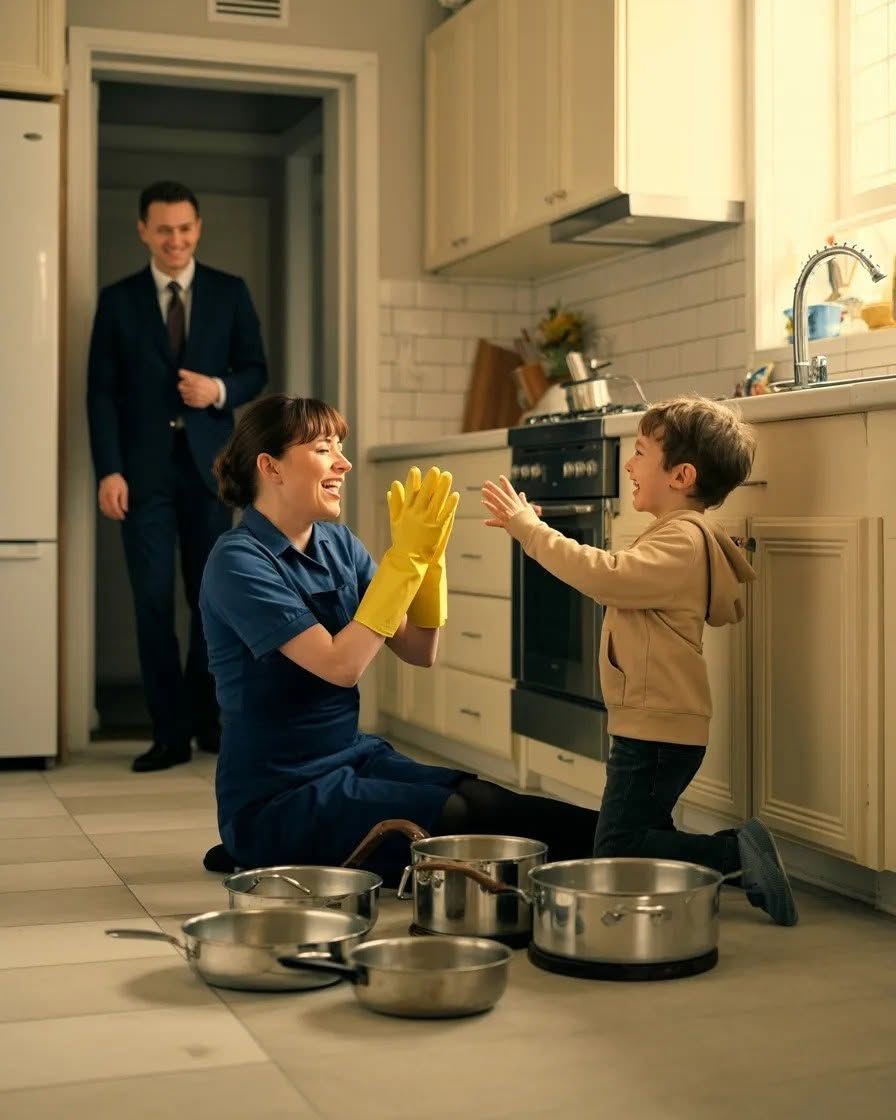
Daniel nodded.
He did not cry. He did not react. It was as if his mind had shut itself down to keep him alive.
The days that followed passed in a haze of white flowers, dark coats, hollow condolences, hospital corridors, legal forms, and awkward embraces from people who did not know what to do with grief that large. At Emma’s funeral, Daniel stood beside her casket like a breathing corpse while people told him what a wonderful woman she had been, what a devoted mother she was, how much she had loved her family. As if he did not already know.
As if knowing it did not make the loss worse. The first night back home, Daniel stood for a long time outside Leo’s room. His son lay in the small hospital bed that had been installed near the window, his tiny legs motionless beneath a blanket, his face pale from surgery and pain medication.
A night-light shaped like a moon glowed on the dresser. A stuffed bear sat beside him, one Emma had bought at a little shop in Evanston because she said Leo needed a companion with a brave face. Daniel looked at his son and felt as though someone had closed a fist around his heart.
Every time he looked at Leo, he saw the car flipping. He saw blood. He saw Emma.
He saw himself, one wet road, one terrible second, and the price that had followed them home forever. From that day on, Daniel began to run. Not physically.
He still lived in the house. He still paid every bill. He still hired doctors, therapists, nurses, and specialists.
He still made certain Leo had the best adaptive equipment money could buy. He ordered custom chairs, specialized beds, pediatric consultations, private physical therapy, and anything else anyone recommended. But emotionally, Daniel disappeared.
He buried himself in work. He accepted more projects. He extended his hours.
He left the house before Leo woke up and returned after his son had already been put to bed. He told himself he was doing it for Leo. For treatment.
For stability. For the best future a child in his son’s condition could possibly have. But the truth, the one he never said aloud, was simpler and uglier.
Daniel could not bear his son’s gaze. In those wide brown eyes, he saw questions he could not answer. Why didn’t Mom come back?
Why can’t I stand anymore? And worst of all, why does Dad look at me like I am a wound? Daniel hired nanny after nanny.
Some were too full of pity, speaking to Leo in soft voices heavy with sorrow until the boy looked away. Others were too cold, caring for him like a list of tasks to be completed before the end of a shift. No one made Leo laugh.
No one made the house feel alive. And Daniel, instead of staying long enough to learn how to face the pain, chose to control everything from a distance. That was when he installed the cameras.
At first, it seemed like a practical decision. A safety measure. A way for him to be at ease while away from home.
He contacted a high-end security company that served executives, celebrities, and politicians, and he requested a system no one would detect. Tiny cameras were placed inside wall clocks, electrical outlets, ceiling corners, and picture frames in the hallway. They ran twenty-four hours a day.
They missed nothing. Daniel told himself he had done it to protect Leo. To make sure no one mistreated his son.
To guarantee that his child would never be helpless around the wrong person. But deep down, he knew the truth. The cameras were another way of avoiding presence.
He wanted to see everything without having to participate. In the evenings, after coming home from the office, Daniel often did not go straight into Leo’s room. Instead, he sat alone in his study while the desk lamp cast a hard circle of light over his exhausted face, and he opened the camera app on his tablet.
He replayed the entire day. He watched Leo eat. He watched Leo sit quietly by the window.
He watched Leo cry and then quiet himself. He watched adults pass by without noticing the look in the boy’s eyes. Eyes searching for something.
Daniel watched, but he did not enter the room. The cameras gave him the illusion of control, but they also built an invisible wall between him and his son. He could turn off the screen whenever the feeling became too heavy.
He did not have to face Leo directly. He did not have to hear his son call for him. He did not have to touch the pain that had not healed.
Then Anna Morales came into the house. She arrived on a Monday morning dressed simply, with her dark hair tied back and her voice low but clear. Daniel barely paid attention during the introduction.
To him, she was only another name on a list of people who came and went. But the cameras noticed everything. From the first few days, Daniel saw something different.
Anna did not rush through her work. She did not fill the silence with loud music or chatter meant for herself. She talked to Leo even when the boy answered only with broken words or small sounds.
She waited for his reactions as if time itself did not matter. She folded laundry near him instead of in another room. She cleaned slowly when he seemed unsettled.
She spoke to him like a child, not like a tragedy. Daniel watched through the screen and felt uneasy. Not because Anna was doing something wrong.
For complete preparation instructions, go to the next page or click the Open button (>). Don't forget to SHARE with your friends on Facebook.