

derful things about you. Daniel talks about you all the time.”
She smelled faintly of vanilla, citrus, and some expensive perfume I could not name. Her voice was low and sincere. She looked me directly in the eye, not challenging, not flirting, not nervous. Just present.
I liked her immediately.
That bothered me more than anything.
Con artists are rarely the cartoon villains people imagine. The good ones are pleasant. Attentive. Intuitive. They make you feel foolish for being suspicious. They build warmth so naturally that by the time they ask for something, you feel almost grateful for the chance to give.
But that first night, I did not let myself think that way.
We had dinner, just the three of us. I made chili because Donna used to say Thanksgiving cooking deserved a warm-up meal, and chili was mine. Vanessa laughed at that and said it was the most sensible culinary philosophy she had heard all year. She asked me about my career, and not the lazy questions people ask retired cops because they want a dramatic story. She asked about patterns in fraud. About why victims hesitate to report. About whether I thought financial crimes were more about greed or loneliness.
Good questions.
Too good, maybe.
Daniel watched us talk with visible relief. That softened me.
Vanessa helped clear the table without being asked and refused to let me do dishes.
“You cooked,” she said. “I can wash a pot.”
Donna used to say that.
I stood there in the kitchen doorway, watching this woman wash my chili pot in the sink where my wife had once stood, and something old and lonely inside me wanted to believe she was exactly who she appeared to be.
That night, lying in bed, I told myself, Maybe this is just a woman my son loves.
Maybe she is kind.
Maybe you are allowed to stop searching for the wire under the flowers.
I almost convinced myself.
Thanksgiving morning came with the usual chaos.
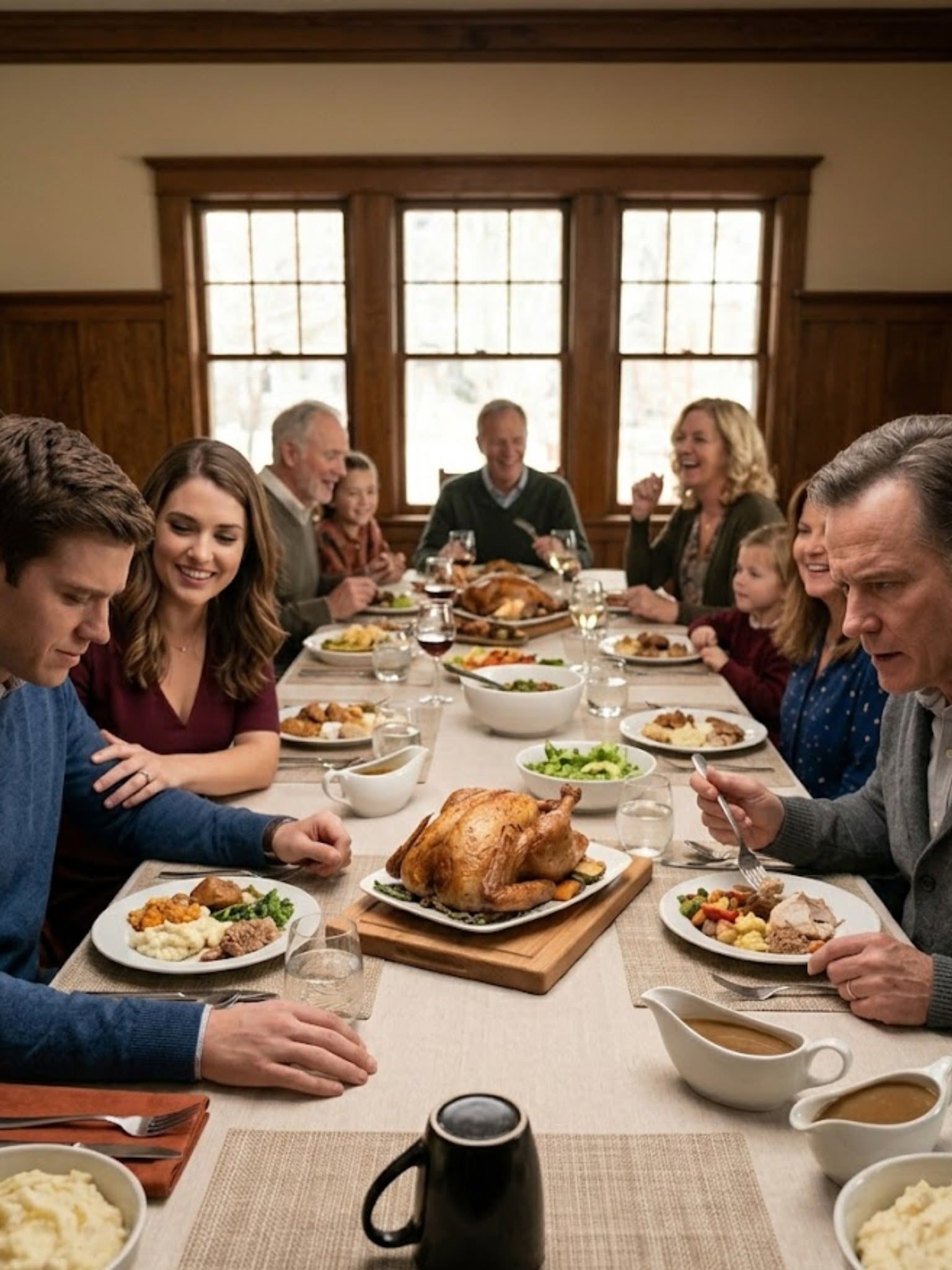
Donna’s sister Carol arrived at nine with her husband Bill and their two teenage kids, Allison and Trevor, who were both at the age where they communicated mostly through hooded sweatshirts and food disappearance. My brother Jim came at eleven with store-bought rolls he had transferred into a basket as if that changed their origin. The house filled up the way it used to before Donna died.
Laughter in the hallway.
Football from the living room.
Carol banging cabinet doors because she insisted she knew where everything belonged and was wrong sixty percent of the time.
Jim asking if I still had the carving knife, which he called “the good one,” though it was just a knife Donna bought at a warehouse store in 2003.
Vanessa fit herself into the house so smoothly that even Carol noticed.
By ten, she was in the kitchen helping with the sweet potatoes. By ten-fifteen, she knew where the casserole dish was. By ten-thirty, Carol found me in the living room and said quietly, “I like her, Robert. She’s good people.”
I nodded.
I wanted that to be true so badly I almost missed the mug.
Almost.
Daniel walked into the kitchen to refill his coffee. He reached past me for the pot. As he set his mug down, he turned it upside down on the table.
One second.
Handle pointing toward me.
Then he flipped it back over, filled it, and walked away.
To everyone else, it was nothing.
To me, the room narrowed.
Sound dropped back.
The turkey timer ticking on the counter. Carol asking Vanessa about Atlanta. Jim yelling at the television. A chair scraping in the dining room. All of it moved away from me, like I had stepped behind thick glass.
I looked at Daniel.
He smiled.
Not with his eyes.
Then he laughed at something Vanessa said.
I picked up my fork and put turkey on my plate.
I chewed. I swallowed. I passed the gravy. I complimented Carol’s dressing. I told Jim the Lions were going to break his heart again because some traditions are stronger than evidence.
Inside, I was already working.
After the meal, while Carol and Jim watched football and Vanessa laughed with the teenagers in the living room, I found Daniel in the garage pretending to search for a board game nobody had requested.
He stood near my old workbench, the same one where we used to fix bicycle tires and build model cars. A box of Christmas lights sat open beside him. He had one hand on the edge of the bench and the other pressed against his forehead.
I stepped in and closed the door behind me.
He turned.
The smile was gone.
“How long?” I asked.
He exhaled as if he had been holding his breath for weeks.
“I’ve been trying to figure out how to tell you for six weeks.”
I leaned against the workbench. “Tell me everything. Start at the beginning.”
He sat down on an overturned crate. For a moment he looked young in a way I hated, not childish, but wounded by his own judgment.
“She’s been talking about Meridian Capital Partners since July,” he said. “At first it was casual. She’d mention a client who made a great return or a fund that was outperforming the market. I didn’t think anything of it. She works in finance. It made sense.”
“When did it stop being casual?”
“August.” He rubbed both hands over his face. “She sat me down and said she wanted to be transparent with me. That she felt like we were getting serious and she didn’t want money to be weird between us. She said Meridian had a new fund launching, a private offering only available to people inside the firm and their close contacts.”
I kept my expression still.
“She said she wanted me to have access because she loved me,” Daniel continued. His voice tightened on the word loved. “She said she wanted us to build something together.”
I knew the script.
I had read versions of it in case files for two decades.
Romance layered over opportunity. Intimacy used as a delivery system. Scarcity, secrecy, privileged access, future language.
“What’s the minimum investment?” I asked.
“Fifty thousand to start. But she made it sound like that was just entry level. She said some of her clients were putting in three, four hundred thousand.”
“Has she shown you documentation?”
“She showed me a prospectus. It looked real, Dad. Like, real real. Formatting, disclosures, SEC registration numbers, risk language, all of it. I looked up Meridian Capital Partners online. There’s a website. Client testimonials. LinkedIn profiles. Press releases.”
“Daniel.”
He looked at me.
“How much of your savings have you moved so far?”
He swallowed.
“She hasn’t asked me to move anything yet.”
That surprised me, but only slightly. The best ones do not ask too early.
“She says she doesn’t want to pressure me. She says she wants me to feel completely ready.”
“But there’s a deadline.”
His eyes flicked up.
“Two weeks ago she mentioned the fund’s entry window closes January fifteenth. After that, she says, it won’t be available again for at least three years.”
Artificial urgency.
Classic.
“And your 401(k)?” I asked. “Has she mentioned it?”
Daniel stared. “How did you know?”
“Because that’s where the real money is for someone your age. Savings account is the conversation opener. Retirement account is the target.”
He looked down at the concrete floor.
“She said if I really wanted to maximize the opportunity, I should think about whether I had any assets I wasn’t actively growing. She didn’t say 401(k). She just left the door open.”
“And that’s when you knew.”
He nodded slowly.
“I work in cybersecurity. I know what social engineering looks like. I’ve literally trained people on pretexting and trust exploitation. I kept telling myself this wasn’t the same thing. That she was different. That I was overthinking it because of my job.” His voice dropped. “Then I realized I might be underthinking it because I didn’t want it to be true.”
I walked over and sat beside him on a second crate.
For a while, neither of us spoke.
Garages are good places for hard silence. They have shelves, tools, old paint cans, and enough dust to make grief feel less formal.
“You placed the mug,” I said.
“You remembered.”
“I never forgot.”
His face twisted.
“I didn’t know how to say it out loud,” he said. “She’s in your house. Everyone likes her. I liked her. I still…” He stopped himself. “I needed to tell you without telling everyone.”
“That was the whole point of the signal.”
He leaned forward, elbows on knees, hands clasped hard.
“I feel stupid.”
“You’re not stupid.”
“I should have seen it sooner.”
“You saw it before you moved money. That’s not late. That’s early.”
He looked at me like he wanted to believe that.
So I made my voice firmer.
“Daniel, listen to me. The people who do this well are professionals. They study loneliness the way surgeons study anatomy. Intelligence doesn’t make you immune. Sometimes it makes you easier to trap because you keep explaining away the emotional evidence with logical excuses.”
He let out a humorless laugh. “That supposed to make me feel better?”
“No. It’s supposed to make you stop blaming yourself long enough to think clearly.”
He nodded.
“Do we confront her?” he asked.
“Not today.”
“What do we do?”
“Tonight, we eat pie. You act normal. I act normal. Tomorrow I start looking.”
He closed his eyes.
“Dad?”
“Yeah.”
“I loved her.”
Past tense.
Not love.
He had already moved it.
“I know,” I said.
We returned to Thanksgiving as if nothing had happened.
That evening, I became the most pleasant version of myself I had been in years. I told stories from my early career, carefully chosen ones with funny endings and no dead bodies. I helped Jim clean the kitchen. I complimented Vanessa on the sweet potato casserole. She beamed and touched Daniel’s shoulder. Daniel smiled when appropriate. Carol whispered to me again that Vanessa was a keeper.
“Maybe,” I said.
Carol thought I was being emotionally guarded.
She was not wrong.
Vanessa was good.
That is the truth I still think people need to understand. She was warm in a way that felt authentic because some part of it probably was. Not all manipulation is fake in the simple sense. Sometimes the affection is real enough in the moment, but it is harnessed to a purpose. Sometimes predators enjoy the people they target. Sometimes they are tender while sharpening the blade.
That night, after everyone went to bed, I sat at the kitchen table with my old laptop and worked until two in the morning.
Meridian Capital Partners had a professional website. Clean design, not too flashy. Three years of domain history, which meant this was not a weekend scam. Listed office in Scottsdale. Team bios. Quarterly market commentary. A page on disciplined growth strategies. A client login portal that did nothing except accept an email address and display a maintenance message.
What it did not have was registration in the SEC Investment Adviser Public Disclosure database matching its claimed assets under management. The numbers did not line up. A firm managing what it claimed to manage should have had a certain kind of footprint. It didn’t.
The address led to a virtual office provider.
The phone number routed through VoIP.
The testimonials used first names and last initials, never full identities.
The headshots on two team profiles appeared, after reverse image digging, on unrelated corporate template sites.
Vanessa Morfield was harder.
There were two Vanessa Morfields in the Atlanta area on social media. Neither matched her age or appearance. The LinkedIn profile for Daniel’s Vanessa had been created fourteen months earlier. Too polished, too complete in some places, too hollow in others. Her listed experience had no tagged colleagues older than a year. Her education had no alumni interaction. Her recommendations read like copywriting.
Then I found Vanessa Morton.
A 2019 civil filing in Maricopa County. The case summary was mostly sealed, but not perfectly. I had spent half my career finding what people thought was hidden because they used the wrong folder or filed one exhibit publicly by mistake. The deposition notice had a photo attachment. Older hair, different color, softer jawline, but the cheekbones were the same.
The plaintiff was a retired teacher named Gerald Huang. He had accused her of defrauding him of eighty-seven thousand dollars through a fraudulent private investment vehicle.
The case settled.
The record sealed.
She walked away.
I wrote everything down in a notebook because old habits outlive software.
At 2:07 a.m., I texted Pete Okafor.
Need to talk. Not urgent enough for tonight, but soon.
Pete still worked financial crimes for the county. We had spent twelve years together building cases nobody cared about until the numbers got big enough for headlines. He was careful, patient, and allergic to drama. He had once spent three weeks tracking a forged signature through six bank branches and described the result as “moderately interesting.”
He replied at six.
My office Monday?
I wrote back: I’ll come to you.
Friday after Thanksgiving, I took Daniel fishing.
We had not done that since he was a teenager. Vanessa said it was sweet. She stood in the driveway wearing one of Daniel’s sweatshirts, holding a travel mug, and waved as we pulled away.
On the drive out, I told Daniel what I had found.
Meridian discrepancies. The virtual address. The LinkedIn timeline. The Maricopa case. Gerald Huang. Vanessa Morton.
He sat in the passenger seat staring through the windshield at the desert road, his hands folded so tightly his knuckles went pale.
“She told me she’d been burned by an ex who spread lies about her online,” he said finally. “That’s why her digital footprint was minimal. She said she deliberately kept a low profile because she didn’t want old drama affecting her career.”
“Inoculation,” I said.
“What?”
“She gives you the explanation before you find the problem. So when you find it, you already have her answer in your head.”
He nodded slowly.
We reached the lake and fished badly for three hours.
Neither of us cared.
Sometimes the purpose of fishing is to give men a direction to face while difficult things exist beside them.
Near noon, Daniel said, “How do we do this?”
“Carefully,” I said. “And not alone.”
For complete preparation instructions, go to the next page or click the Open button (>). Don't forget to SHARE with your friends on Facebook.