

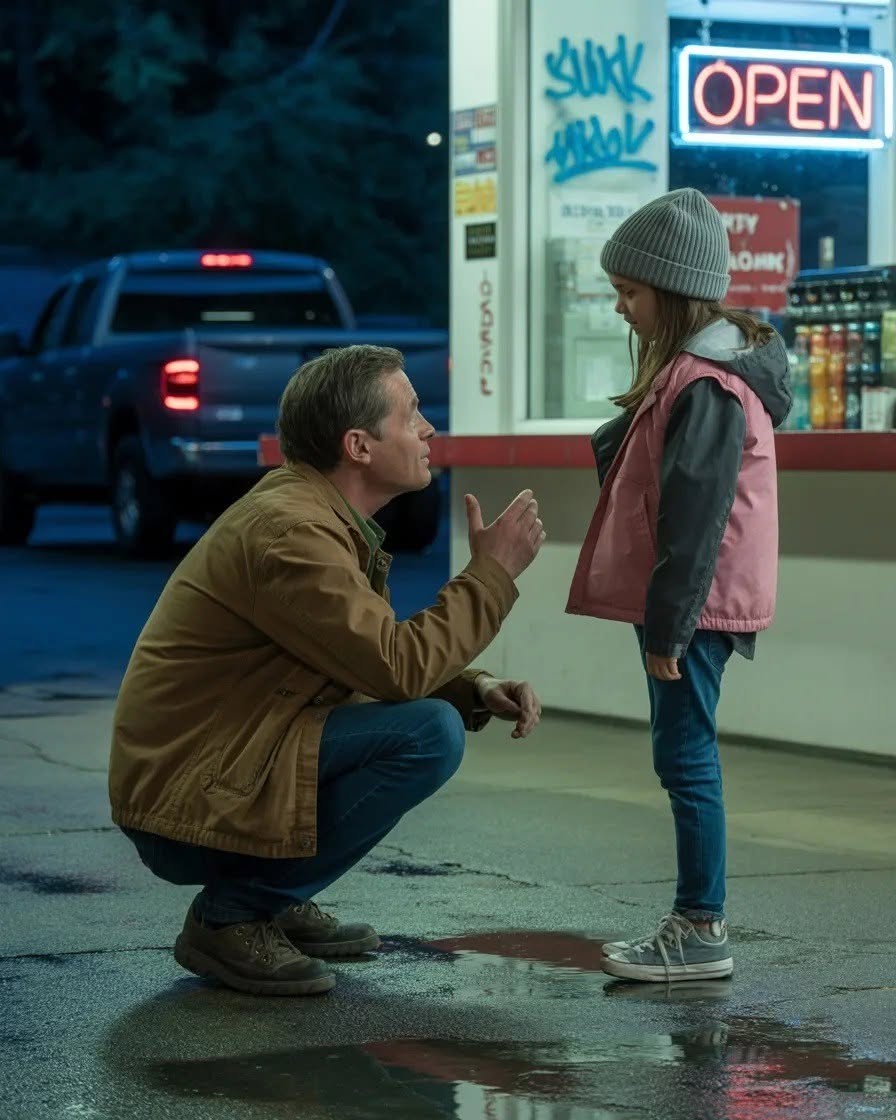
He took a breath and let his frustration sit where it belonged. Not on Sophie. Not on Nina.
Not on the people trying to keep one more child from being moved carelessly through a system that had already missed too much. At midmorning, Margaret brought Sophie to the kitchen. Scrambled eggs, toast, orange juice.
Daniel sat at the far end of the table with a notepad, a pen, and a list of calls he needed to return. He said he had things to take care of and that he would be back by noon. At ten-thirty, he left through the side door with his truck keys in his hand, careful not to turn the leaving into a promise bigger than the one he could keep.
Sophie sat at the other end of the table and ate without looking at anyone. The kitchen had enough Christmas in it not to feel like nothing. A string of colored lights taped above the sink.
A small ceramic tree beside the toaster. The smell of coffee and something sweet from a candle on the windowsill. Enough to mark the day without pressing on anyone about it.
By afternoon, Margaret had chili going in the crockpot and boxed cornbread cut into squares on a plate. The four of them—Margaret, Sophie, Nina, and Daniel—ate at the kitchen table the way people eat when they have not chosen each other but are managing the situation decently. Sophie kept her eyes down mostly.
Once or twice, she looked toward the hallway the way she had looked toward Route 30 the night before. Not afraid. Tracking.
Daniel had returned through the side door at eleven fifty-eight. Sophie had not looked up, but something in her posture settled. Shoulders.
Jaw. The set of her hands. She reached into her lap and brought the paper angel up onto the table beside her tray.
Not clutched. Not hidden. Just out.
Daniel sat down, ladled himself chili, and did not remark on any of it. They ate. After a while, Sophie put her spoon down, looked at the cornbread square on his tray, and pushed half of hers across the table toward him.
No comment. No eye contact. Just a small square of cornbread sliding over the old table.
Daniel took it and ate it. That was all. Margaret turned back toward the counter.
She had been watching the window anyway. Daniel caught Nina in the small office off the hallway before she left for the afternoon. She was going through notes, a legal pad open beside a folder that had gotten thick fast for a case less than a day old.
“He called,” she said before Daniel asked. “Last night after eleven. Contacted the county intake line.
Said it was a misunderstanding. A family argument. His daughter was outside briefly while he went into the store, and then some strangers got involved.”
“What name?” Daniel asked.
“Michael Delaney.”
Daniel stood with that for a moment. Not Dale Hensley. Nina closed the folder.
“He said he’ll have documentation ready. Birth certificate, proof of address, employment verification. He’s asking for her back.”
“And if the documents check out?”
Nina looked at him evenly.
“Then the county has to put reunification on the table. I know what you saw last night in that parking lot. Ray knows what the records show.
But if Michael Delaney walks in tomorrow morning with enough paper to establish standing, the process requires us to consider it.”
She paused. “That’s the honest answer.”
Daniel leaned against the doorframe. “She kept her shoes on all night,” he said.
“Even after she fell asleep. They were on the floor next to the bed, toes pointed out.”
“I know,” Nina said. “Does a birth certificate change what that means?”
“No.
It doesn’t.” She held his look. “But it means we’re all going to be in a room together by morning. I need everything Ray has before then, and I need it organized.”
Daniel nodded and pushed off the doorframe.
In the kitchen, Sophie was still at the table, both hands around a glass of water. The paper angel lay flat in front of her. She was pressing the repaired fold lines smooth with her thumbs, patient and methodical, the way people work their hands when their minds have somewhere uncomfortable to be.
The afternoon light through the kitchen window was thin and flat, that particular gray of Ohio in late December when the clouds sit low and even and do not look as if they are going anywhere. By the next day, a man with a prepared story and a folder of documents would walk into a county office and ask for his daughter. What the records knew about him was still being assembled.
What Sophie knew, she was keeping inside the fold lines of a paper angel her mother had made. By morning, Michael Delaney’s appointment had been pushed to late afternoon because of holiday staffing, one missing records release, and a lawyer driving in from Columbus. It gave Ray a few hours Daniel had not expected.
Neither of them wanted to waste them. Ray had been working addresses since before sunrise. By the time Daniel pulled into the county lot with two gas station coffees, Ray had a short list printed on a single sheet.
Three extended-stay properties. Two outside Columbus. One near Mansfield.
Cross-referenced against the names Michael Delaney and Dale Hensley. All of them sitting inside the cluster of counties where Sophie’s school records went quiet. Daniel looked at the page.
He picked up one of the coffees and held it without drinking. “You recognize any of those?” Ray asked. “One of them,” Daniel said.
He did not explain right away. The name on the list had already put a cold weight behind his ribs. They drove to Mansfield first in Ray’s county car.
The property was a two-story weekly-rate motel off a service road, the kind that put its prices on a changeable letter sign out front. Half the letters were mismatched from a prior set. The lot needed repaving.
The exterior stairwell door did not latch. The man behind the front desk was in his fifties, thickset, and became very measured the moment Ray held up his badge. He answered questions carefully, not evasively, just in the particular way of someone who had learned that short answers kept things from becoming complicated.
Daniel left them to it and walked the exterior corridor. Not as a trespasser. Not quite as an owner willing to say the word out loud.
Property records gave him the right to be there. Shame made him move quietly. The occupied rooms were closed.
He did not knock on any of them. At the far end of the second floor, a housekeeper had propped open a unit being turned over, and Daniel stopped at the threshold without stepping in. A water stain spread from the ceiling corner.
A window air-conditioning unit had duct tape along the seal. A single hot plate sat on the dresser beside a box of instant oatmeal and a plastic spoon. A child’s crayon drawing was tacked to the wall above the television.
A house with a large yellow sun. The way children draw houses before they have lived in enough places to know better. It had been left behind when the room cleared.
Daniel looked at it for a moment and then walked back down the corridor. The Columbus property was three floors, exterior walkways, vending machines humming on each level. In the back lot, two cars had been parked long enough that snow had built up past the wheel wells.
The security camera above the office door had a power cable that ran nowhere. In the lower corner of the office window, taped flat against the glass on the inside, was a paper ornament. Folded from printer paper.
Something cheap and bright enough for December because the window would have looked too bare without it. Daniel stopped on the walkway and looked at it through the glass. He stood there a while.
Ray came up beside him, looked at the same window, and did not ask any questions. They walked back to the car and sat with the engine running for heat. “I have a real estate holding company,” Daniel said finally.
“Set it up about twelve years ago. Extended-stay and weekly-rate properties. They run a certain way.
High occupancy. Low overhead. You keep the right people managing them and you don’t have to think about it much.”
He turned the coffee cup in his hands.
“I never came out to look at any of them. Didn’t seem necessary.”
Ray kept his eyes on the windshield. “Todd Baines runs regional operations,” Daniel continued.
“Seven properties, maybe eight. He told me last spring occupancy was up in the extended-stay units. Said the weekly market was running stronger than projected.”
A truck moved past on the beltway ramp, trailing a low spray of highway slush.
“I thought that was good news,” Daniel said. The heater ran between them. Then Daniel said what had been forming since the first motel.
“He’s been carrying long-term cash tenants off the books. Families who need to stay under the radar pay weekly. They don’t complain.
They don’t want anyone looking at them any more than the manager wants anyone looking at him. It works as long as nobody asks.”
He set the coffee in the cup holder. “Baines made sure nobody did.”
“Staff would have known,” Ray said.
“Staff knew what they were told to know. That a full property is a well-run property. That questions are bad for margins.”
Daniel looked out at the lot.
He had built a business around the idea that distance was the same as cleanliness. Stay out of the day-to-day. Let professionals handle operations.
Keep the paperwork tidy. Collect the return. Write checks to shelters and food banks and tell yourself that balanced something.
It had never occurred to him to ask what his own properties looked like from the inside of a room. Sophie had not fallen through cracks in the system. She had moved through the exact kind of managed blindness Daniel had paid someone to maintain.
“I need the Mansfield records,” he said. “Everything Baines filed. Everything the front desks were told to do with long-term tenants and complaints.
All of it.”
“That opens up more than just this case,” Ray said. “Good.”
Daniel looked at him. “Don’t clean anything up before we go through it.
Don’t tip off management. Put my name on whatever statement you need.”
Ray nodded once. The heat ran.
A minivan pulled out of the lot and turned toward the beltway. Daniel watched until it was gone. He had avoided putting his name on anything that required explaining himself for most of his adult life.
Not out of dishonesty. Not exactly. Just habit.
Quiet money. Quiet distance. It had been comfortable.
“I’m going on the record,” he said. “Whatever you need.”
Ray did not answer right away. He checked his mirror, shifted the car into drive, and pulled out of the lot.
Neither man spoke for a while. The beltway fed back toward the county road, and the flat gray Ohio sky sat low over all of it. Somewhere in a shelter eleven miles east of Morrow County, a nine-year-old girl was waiting to find out what the adults were going to do next.
Michael Delaney came to the county office with a lawyer. Not a criminal attorney. A family law attorney.
Youngish, with a leather portfolio and the kind of careful composure that gets practiced in advance. Michael himself wore a clean shirt. He kept his hands flat on the table.
He had prepared. What he brought was not much, but it was not nothing. An old tax return with Sophie listed as a dependent.
A lease from eight months back, a Columbus address, his name on it. A letter from a former employer confirming work dates that had ended before Christmas. None of it demonstrated stability.
None of it demonstrated care. But it established a presence on paper, and a process that runs on documentation has to treat paper presence as something. Nina called Daniel that afternoon.
The county could not move on immediate protective placement. Not yet. The motel records Daniel had flagged were under review, but that review had its own timeline, and the custody question could not wait on it.
They were scheduling a formal emergency review. In the meantime, Sophie needed to complete a forensic interview at the Child Advocacy Center. A trained specialist would take her living history, names, addresses, and timeline on the record.
Daniel said he understood and ended the call. Then he sat in his truck in the county lot for several minutes before driving back to Hope Harbor. Margaret met him in the hallway and kept her voice down out of habit.
“She knows something shifted,” Margaret said. “Hasn’t said it, but she barely slept and she’s been quiet in that particular way today. Not calm.
Contained.”
“I want to tell her she won’t have to go back to him,” Daniel said. Margaret looked at him. “Can you promise that right now?”
He did not answer.
“Then don’t say it,” Margaret said. “She’s heard that sentence before from people who meant it and ran out of road. Another version doesn’t help her.
It just adds one more adult to the list she’s keeping.”
Daniel stood with that. After a moment, he asked, “So what does help?”
Margaret’s answer was short. “The same thing that worked on Christmas Eve.
Show up when you said you would. Don’t make it bigger than it is.”
He came back the next morning. He had stopped at a sporting goods store on the way.
Insulated boots, the right size as best as he could judge from the worn-out sneakers he had seen beside her bed at the shelter. He had measured the old sole against his palm and done his best. He left the boots outside the dorm room door without knocking.
He was not certain they would fit. They did. He had also found a charger compatible with the small MP3 player Margaret had mentioned in passing, an old scratched thing Sophie ran through earbuds at night, its battery nearly gone.
He left the charger on the kitchen table. Then he poured himself coffee, sat at the far end of the table, and did nothing else. Sophie came in about twenty minutes later.
For complete preparation instructions, go to the next page or click the Open button (>). Don't forget to SHARE with your friends on Facebook.