

Instead, I walked around my desk, knelt down in my tailored navy skirt, and reached into the trash can. My fingers brushed the damp coffee cup, closing firmly around the cold silver of the pen. I pulled it out, wiped it deliberately on a clean tissue, and slipped it into the inner pocket of my blazer.
Then, I picked up the cardboard box.
“Have a nice morning, Martin,” I said, my voice as calm and flat as a frozen lake.
Martin blinked. The smirk faltered for a fraction of a second. He had expected begging. He had braced for anger, for tears, for a pathetic display of desperation that would validate his superiority. Instead, he got chilling politeness.
That seemed to irritate him more than a screaming match ever could.
“Security will escort you down,” he snapped, turning his back on me.
Two heavily built security guards—men I knew by name, men whose kids’ graduation gifts I had personally funded—flanked me at the elevator. They looked deeply embarrassed, their eyes fixed firmly on the carpet the entire way down.
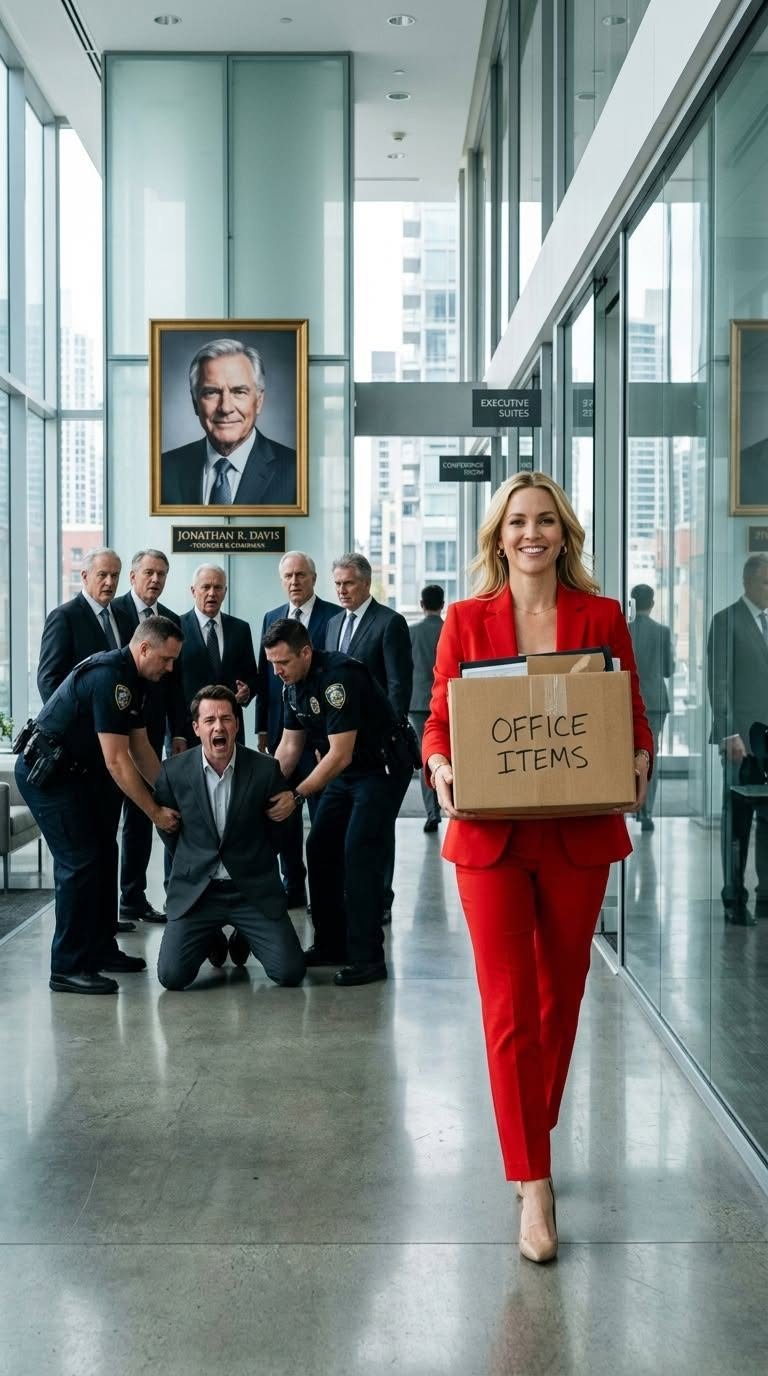
When the brass elevator doors opened on the ground floor, I stepped out into the grand lobby. I walked past the massive, oil-painted portrait of the founder: Arthur Tennant, standing proudly outside the original brick factory in 1978, his sleeves rolled up, sawdust dusting his heavy leather work boots.
My grandfather.
Martin had been so obsessed with my current job title that he had never bothered to ask for my maiden name.
I walked out the revolving glass doors and sat on the cold stone bench near the street. At exactly 10:03 AM, my cell phone vibrated violently in my pocket.
It was Nina, whispering so frantically her voice was barely recognizable.
“Clara! Oh my god, Clara, are you still in the building?”
“I’m outside, Nina. Breathe. What’s happening?”
“He’s in the main boardroom,” she stammered, the sound of rushing footsteps echoing through the receiver. “Legal just opened your employment file to process the severance. Mr. Sterling is in there. Martin is screaming at the top of his lungs. He’s throwing papers. He just yelled, ‘Clara Tennant—who the hell is she?!’”
I smiled down at the pathetic cardboard box resting on my lap, tracing the edge of my blazer where the silver pen rested against my heart.
“Tell him,” I said softly into the phone, “that I’m the woman he needed written permission to fire.”
Then, Nina’s voice dropped to a terrified whisper. “Clara… that’s not the worst part. I saw the presentation deck on his laptop before he went in. He isn’t bringing in consultants. He’s selling the manufacturing division. The vote is happening in twenty minutes.”
The cold wind biting through my navy blazer suddenly felt entirely irrelevant. The ambient noise of city traffic faded into a dull, rushing static.
Selling the manufacturing division.
I gripped the phone tighter. “Nina, read me the name on the presentation deck. Who is he selling it to?”
“It… hold on, I wrote it down on a post-it,” she whispered, papers shuffling in the background. “Apex Global.”
My blood ran absolute ice.
Apex Global. It wasn’t just a competitor. It was the massive, predatory conglomerate that had spent the entirety of the 1990s trying to crush my grandfather’s business through hostile price wars, supply chain sabotage, and aggressive litigation. They were corporate vultures. They didn’t buy companies to run them; they bought companies to strip them for parts, liquidate the assets, and fire the entire workforce to eliminate market competition.
If Martin sold the manufacturing division to Apex, four thousand people across three states would lose their jobs by Christmas. The factories would be gutted. A fifty-year legacy would be turned into a tax write-off.
I hung up the phone and stood up from the stone bench, leaving the cardboard box sitting exactly where it was.
I walked back through the revolving glass doors of the lobby. The two security guards at the front desk stiffened as I approached, exchanging nervous glances.
“Clara,” the older guard, Dave, said softly, stepping in my path. “You know I can’t let you back up there. My job is on the line.”
“I know, Dave,” I said, coming to a halt directly beneath the towering portrait of my grandfather.
I looked up at the oil painting. Martin walked past this portrait every single day. He loved to complain about how the heavy gold frame clashed with his modern, minimalist vision for the lobby. But because he only ever looked up at the CEO suite, he never bothered to look down at the small, polished brass plaque affixed to the bottom of the frame.
It read: “To the true heir, C.T. – Protect the house.”
He never asked who C.T. was. He assumed, like everyone else, that the CEO—my aunt, Elaine—held all the cards. He assumed the quiet woman in the corner office managing the ledgers was just a glorified accountant.
I pulled my phone out and dialed a number I hadn’t called in three years. It rang only once.
“Sterling, Bates & Associates. How may I direct your call?”
“Put Harrison Sterling on the line,” I commanded. “Priority override. Authorization code: Tennant-Echo-Seven.”
Ten seconds later, the gruff, gravelly voice of my grandfather’s oldest attorney and the chief executor of the family trust echoed in my ear. “Clara? I’m currently sitting in a boardroom watching a very expensive suit have a spectacular meltdown over your last name. Tell me you’re still in the building.”
“I’m in the lobby, Harrison.”
“Good. Do not leave.” Harrison’s voice lowered, the professional veneer dropping to reveal the ruthless litigator underneath. “They are attempting to push through an expedited merger vote at 10:30 AM. Martin claims it’s a strategic restructuring, but the paperwork has Apex Global written all over it in invisible ink.”
“I know,” I said, my voice hardening. “He’s intentionally trying to tank our cash reserves to lower the valuation. That’s what the fake vendor contracts were for. He was bleeding us out so Apex could swallow us whole at a discount.”
“Can you prove it?”
“If I have my laptop, yes.”
“He locked your credentials the second you were escorted out,” Harrison warned.
“He locked my employee credentials,” I corrected, a cold smile touching my lips. “He doesn’t know about the root access the IT director gave me during the 2018 server migration.”
“We have twelve minutes, Clara,” Harrison said urgently. “If the board votes to approve the preliminary sale, the injunctions to stop it will take years and millions of dollars. We have to kill it in the room.”
“Trigger the protocol, Harrison. All of it.”
There was a heavy pause on the line. Triggering the protocol meant pulling back the curtain on nineteen years of corporate secrecy. It meant a war that would likely tear my family completely apart.
“Are you certain, Clara?”
“They threw my grandfather’s pen in the trash, Harrison. Open the gates.”
“Understood. I’ll buy you five minutes. Bring backup.”
The line went dead.
I turned my attention back to Dave, the security guard. He looked pale.
“Dave,” I said gently. “In about three minutes, an alarm is going to go off on your security console indicating a catastrophic breach of executive protocol. It’s going to tell you to lock down the elevators.”
Dave swallowed hard. “Clara, please don’t make me—”
For complete preparation instructions, go to the next page or click the Open button (>). Don't forget to SHARE with your friends on Facebook.