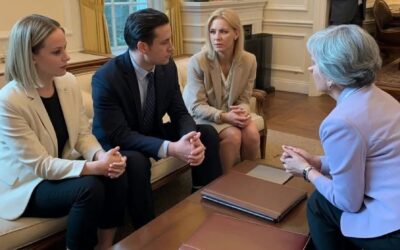


“You’re serious,” Leon said.
“Yes,” I said.
He scoffed. “You think you can turn wolves into bankers because you got a promotion?”
“No. I think both of you nearly lost everything because this world keeps rewarding paranoia, ego, and blood. Adrian exploited that. Calvin exploited that. Others will too.”
Leon’s eyes hardened. “You don’t know this life.”
“I know it better than most people born into it,” I said. “Because I watched it without needing to defend it.”
The words landed.
Even Maxim looked at me differently.
I continued, “You can keep fighting over pieces of a city that is changing without you, or you can move your money into businesses that still exist ten years from now. Logistics. Security. Real estate. Restaurants. Legal ventures with clean books and actual futures.”
Leon laughed under his breath. “You sound like a reformer.”
“No,” I said. “I sound like someone who has read your balance sheets.”
Dmitri coughed once to hide a laugh.
Leon glared at him, then looked back at me.
“And if I refuse?”
“Then Maxim gives the evidence on Adrian to your enemies, your family fractures publicly, and every ally you have starts wondering whether your bloodline is a liability.”
Leon’s smile returned, thin and dangerous.
“There it is.”
I held his gaze.
“I learned from the best.”
He looked at Maxim. “She threatens like you.”
Maxim’s mouth curved slightly. “No. Better.”
Leon sat in silence for a long time.
Then he closed the folder.
“Neutral docks,” he said. “Legal oversight. Shared commercial management. And Adrian?”
Maxim’s expression darkened.
Leon’s did too.
But I spoke first.
“Alive,” I said.
Both men looked at me.
“Adrian faces consequences,” I continued. “Exile. Financial cutoff. Whatever your world requires. But no bodies tonight.”
Leon’s face twisted. “He is my brother.”
“Yes,” I said quietly. “So decide whether you want justice or another ghost.”
That hit him.
I saw it in his eyes.
Behind all the cigar smoke, expensive suits, and cruelty, Leon Volkov was still a man who had once lost someone he loved. The folder had told me that too. His late wife’s charity account. The one Adrian used because grief makes blind spots.
Leon stood.
For a second, I thought he would refuse everything.
Instead, he extended his hand to Maxim.
“Your counsel is expensive.”
Maxim shook his hand.
“Worth it.”
Leon turned to me.
The old mockery was gone.
“Ms. Harper.”
“Mr. Volkov.”
“If you ever get tired of him—”
Maxim’s eyes flashed.
Leon stopped, then gave a small, almost respectful smile.
“Relax, Petrov. I was going to say, if you ever get tired of him underestimating how much trouble you can cause, call me. I enjoy being proven right.”
I surprised myself by smiling.
“I don’t plan to be underestimated again.”
“No,” Leon said. “I don’t suppose you do.”
Three months later, Pier 17 reopened under a legal commercial partnership that made every newspaper in Chicago call Maxim Petrov a visionary investor and Leon Volkov a surprising advocate for waterfront redevelopment.
No one mentioned the supper club.
No one mentioned Adrian’s private exile in a country with no friends and no access to family money.
No one mentioned Calvin Reese.
But dockworkers got safer contracts.
Two illegal routes disappeared.
Three shell companies became legitimate logistics firms.
And I stopped sitting in corners.
My new office was two doors down from Maxim’s. It had glass walls, a real desk, and a view of the river. The first week, I kept expecting someone to ask why I was there.
By the fourth week, department heads stopped looking at Maxim before answering my questions.
By the eighth, they came to me first.
Tatiana, my friend from administration, was promoted to operations coordinator after I found six years of her ignored process improvements buried in archived emails.
“You’re becoming dangerous,” she told me one afternoon, standing in my doorway with coffee.
“I was always dangerous,” I said. “I just used to format the minutes.”
She laughed so hard she nearly spilled her drink.
As for Maxim, he kept his promise.
Mostly.
He listened when I disagreed. He told me truths I did not always want. He assigned security to my building, but my apartment remained mine. He never touched me without permission. He never called me his.
That mattered more than flowers would have.
But flowers came too.
Not dramatic roses or expensive arrangements that looked like apologies.
Small things.
A single white tulip on my desk after my first successful negotiation.
A book on behavioral economics after I complained that half our managers confused fear with loyalty.
A bakery box from downstairs on the anniversary of the day I accepted the job, with a note that said:
You were never invisible. I was simply a coward.
I stared at that note for a long time.
Then I walked into his office without knocking.
Maxim looked up from his desk.
“Is something wrong?”
I placed the note in front of him.
“This is dangerously close to emotional honesty.”
His mouth curved. “I’ll try to recover.”
I sat across from him.
For once, he looked uncertain.
It suited him badly.
“Lissa—”
“No,” I said. “I’m going to speak first.”
He leaned back. “Of course.”
“I spent nine years believing survival meant becoming small. Quiet. Useful. Easy to overlook. Then one day, a terrible man asked if I was single, and another terrible man threatened to remove his tongue.”
Maxim winced. “Not my finest moment.”
“No,” I agreed. “But it was the moment I realized I was tired of measuring my safety by how little space I occupied.”
His gaze softened.
I continued, “You did not save me, Maxim.”
“I know.”
“You opened a door. I walked through it.”
“I know that too.”
“And what happens next between us cannot be another room where you decide the terms alone.”
He was very still.
“What terms do you want?” he asked.
I looked at the man who had frightened a city, defended me badly, respected me better, and learned—slowly, painfully—to stand beside me instead of in front of me.
“I want dinner,” I said. “Somewhere public. No bodyguards at the table. No business. No strategy. No one gets threatened.”
A slow smile changed his whole face.
It made him look younger.
Almost happy.
“That may be difficult.”
For complete preparation instructions, go to the next page or click the Open button (>). Don't forget to SHARE with your friends on Facebook.