

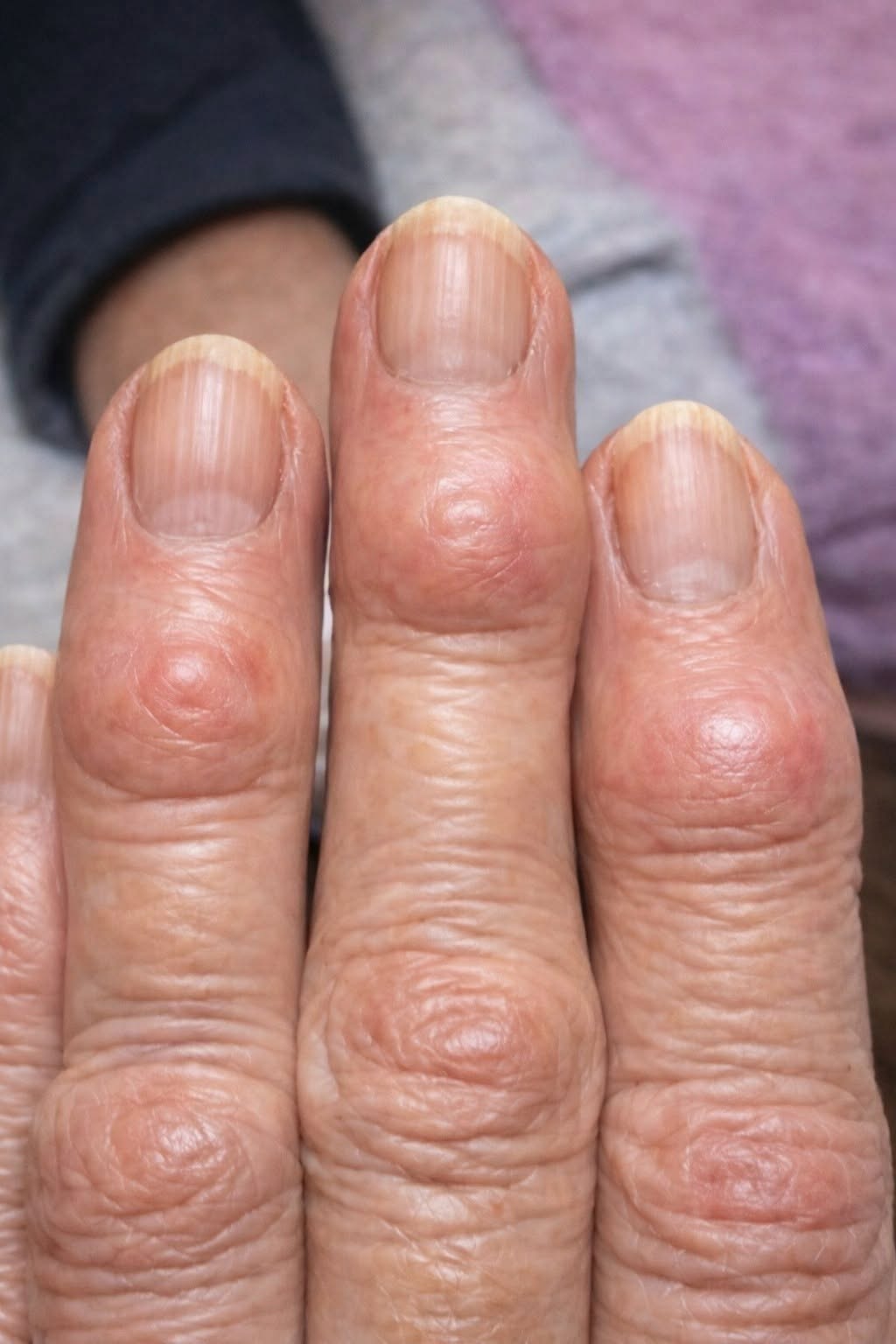
6. Knuckle Pads Can Develop From Repeated Pressure
Some people develop thickened areas of skin over the knuckles known as knuckle pads.
These can appear as firm, skin-colored or slightly thickened areas over the joints.
Repeated friction or pressure may contribute to their development.
They are generally benign.
However, because several different conditions can cause bumps around the knuckles, it’s useful to have unusual or persistent lesions examined if their cause isn’t obvious.
7. Dyshidrotic Eczema Looks Different
Not every hand bump is hard.
Some conditions initially appear as tiny bumps or blisters.
Dyshidrotic eczema, for example, can cause small, intensely itchy fluid-filled blisters on the sides of the fingers, palms, or feet.
The blisters can eventually dry out and leave the skin cracked, peeling, or irritated.
Unlike a typical wart or callus, the major clue is often itching.
People may describe the sensation as extremely itchy or burning.
Triggers can vary and may include irritation, allergies, stress, sweating, or exposure to certain substances.
If the bumps are itchy rather than simply hard and rough, eczema or another inflammatory skin condition may deserve consideration.
8. Digital Mucous Cysts Can Appear Near Fingernails
Another type of cyst that can occur on the fingers is a digital mucous cyst.
These are often found near the last joint of a finger, close to the nail.
They may appear as small, smooth, translucent or skin-colored bumps.
Sometimes they are associated with osteoarthritis in the nearby joint.
In certain cases, pressure from the cyst can affect the nail and create a groove or indentation.
Although they are usually benign, they should not be punctured at home because doing so can introduce bacteria and cause infection.
9. Dupuytren’s Disease Can Cause Firm Changes in the Palm
A less common but important possibility is Dupuytren’s disease, a condition involving the connective tissue beneath the skin of the palm.
It can begin with a small, firm nodule in the palm.
Over time, the tissue can thicken and form cords beneath the skin.
In some people, these changes eventually pull one or more fingers toward the palm, making them difficult to straighten.
Early signs can be subtle.
You might notice a small lump or thickened area before significant finger movement problems develop.
If you notice a firm nodule in your palm accompanied by gradually increasing difficulty straightening a finger, medical evaluation is worthwhile.