

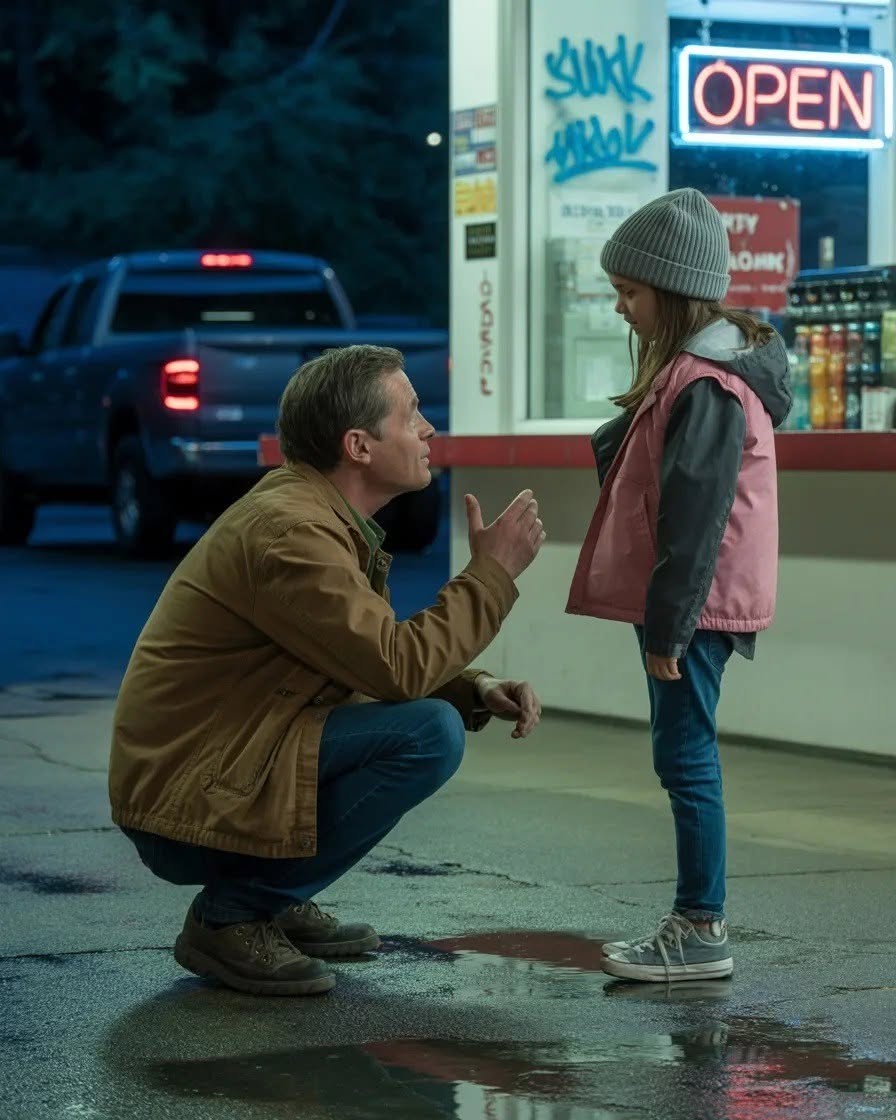
She had taken something from the pantry and carried it upstairs without asking because some part of her believed she would still be allowed back down. Spring came slowly in Ohio. Snow pulled back from the fence line.
The yard turned soft and brown. The school bus started arriving in daylight instead of gray dark. Sophie’s boots were replaced by sneakers that actually fit, though she kept the boots lined neatly by the floor vent for weeks after they stopped being necessary.
Daniel’s house changed in ways he would not have believed could matter. A second toothbrush in the upstairs bathroom. A pink plastic cup beside the sink.
Library books stacked on the end table. A school calendar held to the refrigerator by a magnet shaped like the state of Ohio. A jacket left over the banister one afternoon, then retrieved quickly when Sophie noticed Daniel had seen it.
He did not tell her to leave it there. He did not tell her it was fine. He simply walked past it the next time it happened.
And the next. Eventually, the jacket stayed where it landed until bedtime. The motel investigation widened.
Daniel’s company became a case study in the cost of intentional distance, though no newspaper used those words at first. A local reporter called about “housing irregularities” and “undocumented long-term occupancy practices.” Daniel gave a statement that was shorter than his attorney wanted and more honest than the company’s public relations consultant preferred. “I owned the buildings,” he said.
“That means I owned the responsibility. We are cooperating with the county and state investigators. We are correcting the conditions, reviewing every property, and setting up independent oversight.
I should have asked more questions years ago.”
The consultant told him it sounded too self-incriminating. Daniel said, “Good.”
He sold two properties that could not be responsibly repaired under his ownership and converted another into transitional family housing in partnership with Hope Harbor and county services. He put Margaret on the oversight board.
She told him immediately that she would be difficult. “I’m counting on it,” he said. She gave him the same level look she had given him on Christmas morning.
“You better be.”
By summer, Sophie had grown half an inch. Daniel knew because the pediatrician measured her and because she stood against the kitchen doorway afterward while Margaret made a pencil mark neither of them called ceremonial. Sophie looked at the mark.
Then she looked at the old marks Daniel had made for nothing in particular years earlier, measuring the height of a shelf, a cabinet, a dog he had owned in his twenties. “Can it stay there?” Sophie asked. “The mark?”
“Yeah.”
Daniel looked at the pencil line, small and ordinary on the doorframe.
“Yeah,” he said. “It can stay.”
That night, she placed the paper angel in the blue cookie tin and returned it to the hall closet shelf without checking twice to see if it was still there. That was how Daniel knew something had changed.
Not healed. Changed. Healing was not a straight line.
He had learned not to insult either of them by pretending it was. There were still nights when Sophie woke from dreams and stood in the hallway without calling his name. There were still days when a man’s raised voice in a grocery store made her go silent for hours.
There were still times when she asked whether a plan had changed three different ways before believing the answer. But there were also Saturday pancakes, now less burned because Daniel finally marked the bad burner with a piece of tape. There were library trips.
There was a school project about Ohio history that somehow took over half the dining room table. There was the first time Sophie laughed hard enough at something Ray said that she covered her mouth afterward, startled by the sound of herself. There was the first time she called from the school office because she had forgotten her lunch.
Daniel drove it over. When he arrived, she was standing near the office counter, embarrassed and stiff. “I forgot it,” she said.
“I figured.”
“I’m sorry.”
Daniel handed her the lunchbox. “Sophie,” he said, “people forget lunches.”
She searched his face. “That’s all?”
“That’s all.”
She took the lunchbox slowly.
Then she walked back down the school hallway, turning once near the corner to make sure he was still there. He was. By the time autumn arrived, the legal case had moved from temporary stability toward something more permanent.
Michael’s challenges had weakened under the weight of records he could not explain and testimony he could not reshape. The court did not move quickly, but it moved. Daniel had learned to respect that difference.
On a clear October afternoon, Sophie asked if they could drive past Stovall’s. He did not answer right away. She was in the passenger seat, taller now, her hair pulled back with a clip Margaret had given her.
The fields outside the truck window had gone gold and flat after harvest. “You sure?” Daniel asked. “No,” she said.
“But I want to see it when it’s not that night.”
So he drove. Stovall’s looked smaller in daylight. The outdoor ice freezer was still there.
The orange lot lights were off. A pumpkin display sat near the entrance. Someone had painted a ghost on the front window in white marker.
Daniel parked near the same spot where he had parked Christmas Eve. Sophie sat still for a moment. Then she opened the truck door.
They walked to the far end of the building together. The ground was dry. No slush.
No wind cutting hard across the lot. No dark blue pickup near the road. Sophie stood beside the freezer and looked toward the bend in the highway.
Daniel stayed a few feet away. After a while, she reached into her jacket pocket and took out the paper angel. Not the original one.
That stayed in the tin now. This was a copy she had made with Margaret at the kitchen table, folded from plain white paper, the creases sharp and new. She held it against her stomach for a second.
Then she unfolded it, smoothed it against the top of the freezer, and looked at the road. “He didn’t come back,” she said. Daniel did not correct the tense.
“No,” he said. “But you did.”
“Yes.”
She looked at him. “Why?”
The question was not simple, so he did not insult it with a simple answer.
“I almost didn’t,” he said. Sophie watched him. “I got in the truck.
I turned the key. I told myself a lot of reasons to leave it alone.” He looked toward the highway. “Then I heard what you said.”
“What did I say?”
Daniel swallowed once.
“You said he’d come back after he cooled off.”
Sophie looked back at the road. For a long time, she said nothing. Then she folded the paper angel again.
“I knew he wouldn’t,” she said. Daniel let that stand. “But I thought if I stopped watching,” she added, “then it would be my fault when he didn’t.”
There were things Daniel wanted to say.
None of them were useful enough. So he said the only true thing he had. “It was never your job to make him come back.”
Sophie pressed the fold flat with her thumb.
“I know that now,” she said. And maybe she did not know it all the way. Maybe no one knows a truth like that all at once.
But she had said it in daylight, beside the place where the old lie had nearly frozen around her. That was enough for the moment. Inside the store, the same young clerk was working the counter.
She recognized Daniel first, then Sophie. Her face changed quickly, not with pity exactly, but with the sudden weight of memory. “I wondered,” the clerk said softly.
Sophie stood beside Daniel, hands in her jacket pockets. “I’m okay,” she said. The clerk nodded, eyes bright.
“I’m glad.”
Daniel bought coffee, hot chocolate, and a grilled cheese from the warmer even though neither of them needed it. In the truck, Sophie took one bite and made a face. “It’s kind of bad,” she said.
Daniel looked at the sandwich. “It was bad the first time too.”
Sophie laughed. A small laugh, but real.
It filled the truck more warmly than the heater. When Christmas came around again, Daniel expected it to be complicated. It was.
Not in the dramatic way people imagine. There were no sudden breakdowns under the tree, no single speech that put the past in its place. The difficult parts came quietly.
Sophie avoided the Christmas aisle at the grocery store until December tenth. She asked three times whether the tree would be real or fake. She checked the hall closet twice in one week, then pretended she had been looking for tape.
For complete preparation instructions, go to the next page or click the Open button (>). Don't forget to SHARE with your friends on Facebook.