

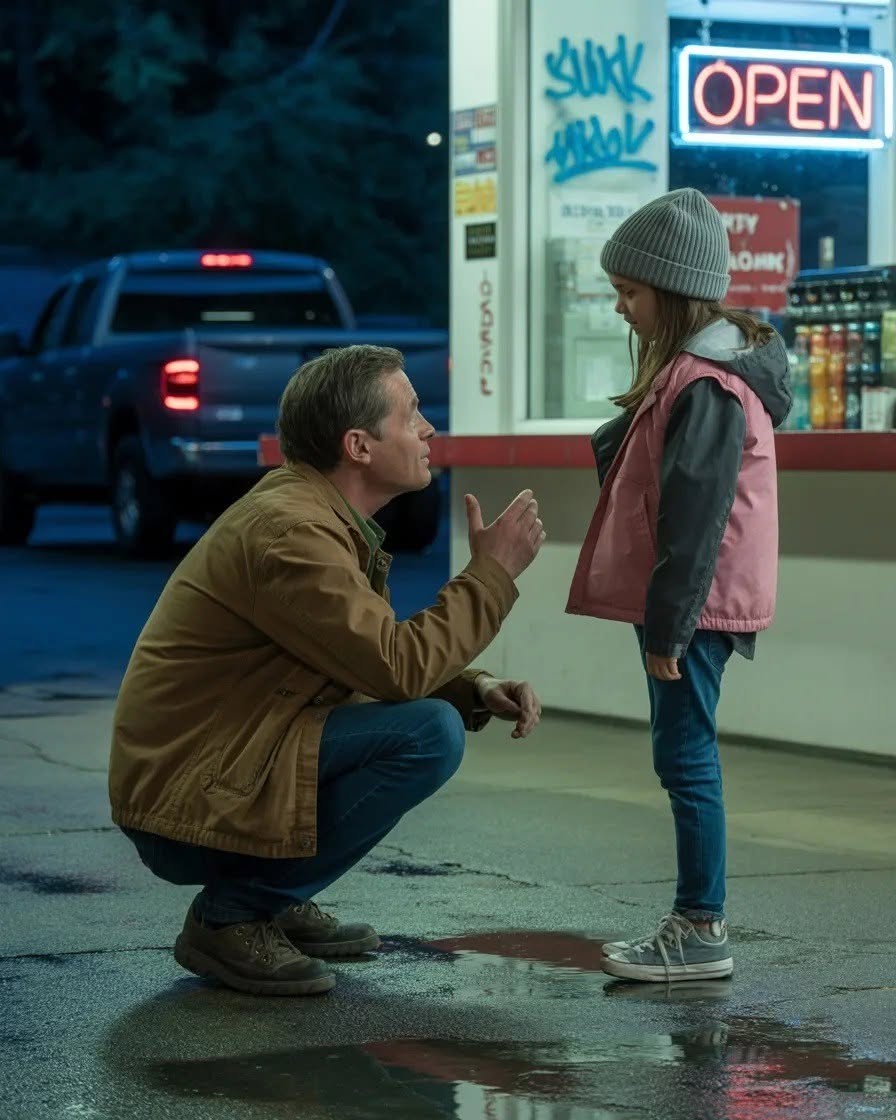
Daniel pretended to believe her. On Christmas Eve morning, Margaret came over with cinnamon rolls and a new ornament: a small wooden house painted blue with a tiny yellow sun in the corner. Sophie looked at it longer than she looked at most things.
“For the tree?” Margaret asked. Sophie nodded. “For the tree.”
That evening, snow began falling after dinner.
Not hard. Not dangerous. Just enough to soften the driveway and settle on the railings.
Daniel had made soup because Margaret insisted Christmas Eve needed something warm that did not require skill. Ray stopped by with a tin of cookies from his wife and stayed for one cup of coffee. Nina called, claiming it was work-related, then admitted she wanted to wish Sophie a peaceful night.
After the house quieted, Sophie went to the hall closet. Daniel was in the kitchen rinsing mugs when he heard the door open. He turned off the water.
Sophie came back carrying the blue cookie tin. The masking tape label had started to curl at one edge. Christmas Sophie’s Angel.
She set it on the kitchen table and opened it. Inside, the original paper angel lay flat, its tape seams yellowing slightly, its folds soft from years of being opened and closed. Sophie lifted it with both hands.
Daniel sat across from her. She did not hand it to him this time. She did not need to.
She unfolded it, smoothed the old lines, and looked at it under the kitchen light. “My mom made it because we didn’t have ornaments that year,” she said. Daniel listened.
“She told me angels didn’t have to be fancy. They just had to know where to stand.”
The words settled into the room. Sophie’s voice stayed steady.
“I used to think that meant the angel was supposed to stand with me.”
Daniel looked at the paper. “Maybe it did.”
“Maybe.”
She ran one finger along the repaired wing. “But I think maybe she meant me, too.
That one day I’d know where to stand.”
Daniel did not move. Sophie looked toward the living room, where the tree stood near the window. The wooden house ornament hung near the middle.
A candy cane rested on a low branch. The lights reflected in the dark glass, and beyond it the yard lay white and still. “Can we put it on the tree?” she asked.
Daniel’s throat tightened. “Are you sure?”
“No,” Sophie said honestly. “But I want to.”
They walked into the living room together.
She chose a branch not too high and not too low. Daniel found a piece of thread and tied it carefully through the top fold. Sophie held the angel while he tied the knot, then placed it on the branch herself.
For a moment, neither of them said anything. The paper angel did not look new. It did not match the glass ball, the wooden star, or the little blue house.
Its tape caught the Christmas lights in uneven lines. Its edges were worn. Its wings leaned slightly to one side.
But it held. Sophie stepped back. Outside, snow touched the window and melted into clear streaks.
“I don’t want to leave it out forever,” she said. “You don’t have to.”
“But I don’t want to hide it either.”
Daniel nodded. “Then we’ll put it away after Christmas.
Same tin. Same shelf.”
Sophie looked at the angel. “And next year?”
“We’ll take it out.”
“And after that?”
“Same thing.”
She turned toward him.
“You mean it?”
Daniel knew by then that the question was not about an ornament. “Yes,” he said. “I mean it.”
Sophie looked back at the tree.
Her face did not change dramatically. She did not throw her arms around him. She did not suddenly become a child untouched by what had happened.
She simply stood there, breathing evenly, in a house where the lights were on, the doors were locked, the pantry had her name on a shelf, and the thing she loved most was hanging in plain sight without having to be guarded in her fist. That was enough. Later, after she went upstairs, Daniel stayed in the living room with only the tree lights on.
He thought about the night at Stovall’s. The cold. The bend in the road.
The little girl beside the ice freezer whispering a sentence she did not believe but could not stop saying. He thought about the motel corridors and the crayon house with the yellow sun. He thought about the blank follow-up field, the off-book rooms, the clean quarterly reports, the comfort he had mistaken for innocence.
For most of his life, Daniel had believed goodness was something you could do quietly from a distance. Write the check. Fund the program.
Keep your name out of the room. Do not need too much. Do not ask too much.
For complete preparation instructions, go to the next page or click the Open button (>). Don't forget to SHARE with your friends on Facebook.